
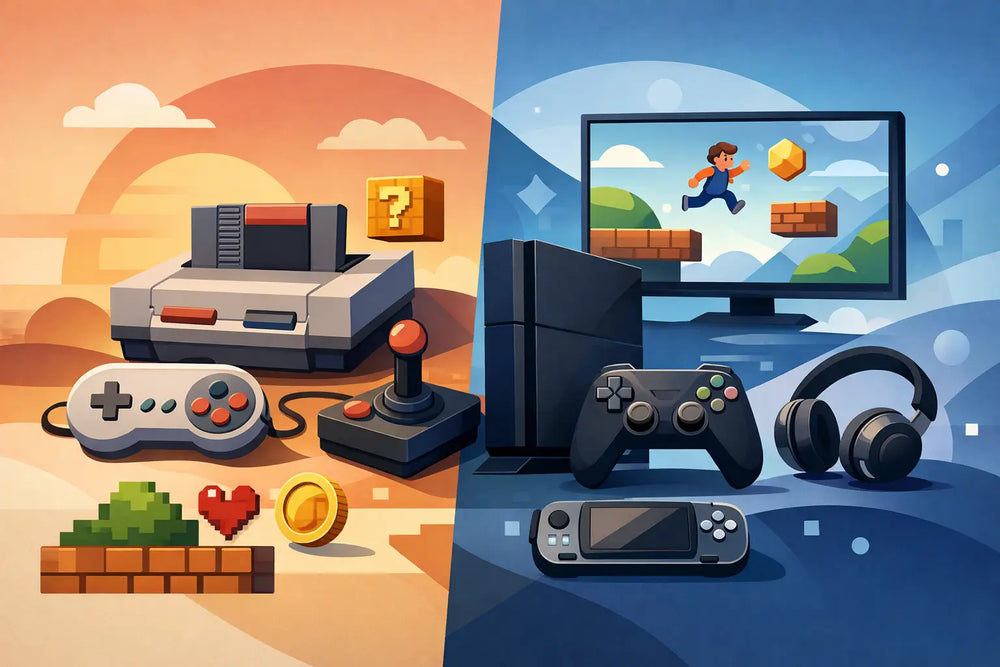
You can spot the question behind a lot of trade-ins and collector buys: what are retro video games, exactly? Most people know the feeling when they see a gray NES cart, a longbox PlayStation game, or a scratched-up Dreamcast case at a shop counter. The harder part is drawing the line. "Retro" sounds simple until you start talking about re-releases, late-generation hardware, handhelds, and whether the Xbox 360 is old enough to count yet.
What Are Retro Video Games?
In practical terms, retro video games are older titles from past console, handheld, and computer generations that are no longer part of the current mainstream market. They usually come from hardware eras that have been fully replaced, and they carry some mix of age, nostalgia, historical value, or collector interest.
That sounds broad because it is. Retro is not a strict technical category with one official cutoff. It is part time period, part hardware generation, and part culture. A game can be old without feeling retro, and a game can feel retro on day one if it is designed around older graphics, sound, or gameplay ideas.
For most players and collectors, the label usually starts with systems like the Atari 2600, NES, SNES, Genesis, Game Boy, PlayStation, Nintendo 64, Saturn, Dreamcast, and often moves into GameCube, PlayStation 2, original Xbox, Game Boy Advance, and DS depending on who you ask. That last group is where opinions start to split.
Why the Definition Changes Depending on Who You Ask
If you ask a collector, retro often means a platform old enough that physical condition, completeness, and authenticity matter as much as the game itself. If you ask a player, retro may just mean anything from their childhood that is no longer easy to buy new at a big-box store. If you ask a repair shop or specialty retailer, retro is usually tied to discontinued hardware generations that need maintenance, part replacement, disc resurfacing, cartridge cleaning, or battery work.
That is why there is no clean universal line. A teenager might call the Wii retro. A longtime collector who grew up on the Atari and NES probably will not. Neither person is completely wrong. They are just using different baselines.
Age matters, but so does distance from the current market. When a system is no longer supported, when its games are mostly found used, and when keeping it running takes actual care, it starts entering retro territory.
Is There an Actual Year Cutoff?
Not one that everyone agrees on.
Some people use a rough 15 to 20 year rule. By that logic, a lot of sixth generation and even some seventh generation games are now old enough to be called retro. Others define retro by generation instead of age, which usually puts the line somewhere before the HD era. That approach tends to treat cartridge based and early disc based systems as clearly retro, while PlayStation 3, Xbox 360, and Wii sit in a gray area.
The trade off with a year based definition is that it is simple but a little blunt. A 2008 game and a 1991 game are both old, but they belong to very different technical and cultural periods. The trade off with a generation based definition is that it makes more sense to enthusiasts, but it can confuse casual buyers.
For a shop environment, the cleanest answer is usually this: if the hardware is discontinued, the physical media is mostly secondhand, and the buying audience cares about condition and originality, you are dealing with retro or close to it.
The Systems Most People Mean When They Say Retro
When customers talk about retro, they usually mean a few major categories.
The earliest group is classic cartridge and early home console gaming: Atari, Intellivision, ColecoVision, NES, SNES, Sega Master System, Genesis, TurboGrafx-16, and Game Boy. These are firmly retro by any standard.
Next comes the 32-bit and 64-bit transition era: PlayStation, Sega Saturn, Nintendo 64, Game Boy Color, and often Dreamcast. This is also solid retro territory, especially because physical media and hardware condition have become a big part of ownership.
Then there is the sixth generation: PlayStation 2, GameCube, original Xbox, Game Boy Advance, and in many cases PSP and DS. These are now old enough that many collectors and specialty stores treat them as retro, even if some players still think of them as "modern enough."
After that, things get less settled. Wii, PlayStation 3, and Xbox 360 are old, collectible in spots, and increasingly repair-relevant, but the word retro still depends on the audience. Some call this era "modern retro" or "early HD," which is not a bad compromise.
Retro Does Not Always Mean Rare or Expensive
This matters because people mix these terms up all the time.
A retro game is simply from an older era. A rare game had limited production, low survival rates, regional exclusivity, or unusual demand. An expensive game is one the market currently values highly. Those are three different things.
A common copy of Super Mario Bros. is retro, but it is not rare. A sealed copy in excellent condition may be expensive, but that is because condition and collector demand change the value. On the other hand, some obscure titles are genuinely hard to find, but they may not sell for much if there is little demand.
This is where physical media matters. Cartridge label wear, cracked cases, missing manuals, resurfaced discs, replaced cases, battery saves, and reproduction parts all affect value differently depending on the platform and buyer. For players, a clean working copy is often enough. For collectors, originality and condition can be the whole story.
What Makes Retro Games Worth Going Back To?
Part of it is nostalgia, and there is nothing wrong with that. People want to replay what they grew up with. They want the exact controller shape, the startup sound, the box art, and the version they remember.
But nostalgia is only half the reason retro holds up. A lot of older games are still worth playing because they are mechanically sharp. You can hand someone Tetris, Super Metroid, Street Fighter II, Chrono Trigger, Sonic 3, Castlevania: Symphony of the Night, or Mario Kart 64 and they still make sense fast. The best retro games get to the point.
There is also a hardware factor. Older systems had stricter limits, so developers leaned hard on level design, controls, music, and clear visual language. That does not make every old game better. Plenty of them are rough, confusing, or badly balanced. But when a retro game is good, it often stays good because the core design is doing the work.
Retro Games vs. Retro-Style Games
This distinction is worth making.
A retro game is an original title from an older generation. A retro style game is a newer release that intentionally uses older visual, audio, or gameplay conventions. Think pixel art platformers, turn based RPGs, or new games built to feel like something from the SNES or Genesis era.
Both can be great, but they are not the same thing. A modern indie game can look 16 bit without being retro in the collector sense. It does not carry the same hardware history, packaging, or platform specific quirks.
That difference matters more if you collect physical media, original hardware, or complete in box copies. If you just want the gameplay feel, a retro style release may scratch the same itch with fewer headaches.
Why Condition and Hardware Support Matter
Retro gaming is not only about the software. Hardware is part of the equation, and aging hardware changes how people shop.
Cartridges get dirty. Save batteries die. Disc games pick up scratches. Pins corrode. Hinges crack. Laser assemblies wear out. Controllers drift, buttons soften, and cables fail. Even when a game is affordable, getting it to run properly can take more effort than people expect.
That is one reason specialty shops still matter in this category. Buyers want to know if a game is authentic, tested, complete, resurfaced if needed, and matched to the correct platform version. They also want to know whether the console itself has been cleaned or repaired well enough to keep playing older libraries without constant problems.
For retro buyers, trust is part of the product. That is true whether someone is hunting a clean SNES cart or trying to keep a PlayStation 2 reading discs properly.
So What Counts as Retro Right Now?
The honest answer is that retro is a moving line, not a fixed wall.
At minimum, most people agree on pre HD generations and earlier handheld eras. Beyond that, the label depends on age, platform support, collector behavior, and how far a system has moved out of everyday retail. A PlayStation 2 library is retro to most shoppers now. A Wii library might be retro to some and just older used stock to others. A PlayStation 3 collection is getting closer every year.
If you want the simple shop floor answer, use this: retro video games are games from discontinued generations that people still seek out for play, collection, or preservation. That includes titles where the original hardware, packaging, and condition still matter.
At Game Quest, that is usually the point where a game stops being just used and starts being part of gaming history. If you are buying retro, buy with clear expectations about platform, condition, and whether you want a shelf piece, a play copy, or something in between. That saves a lot of disappointment and usually leads to a better collection.