
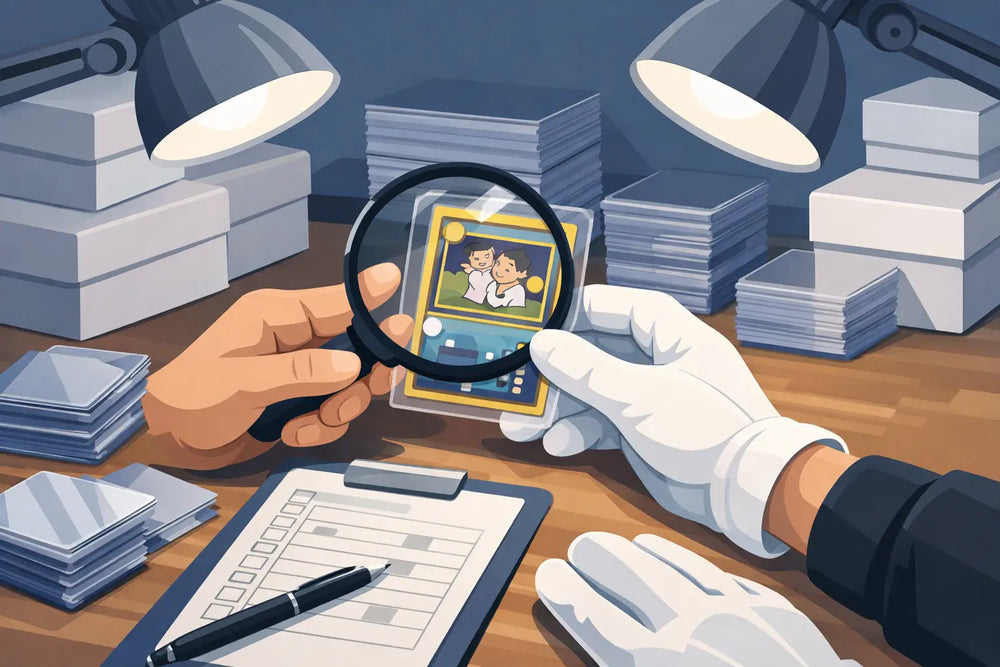
A card can look clean in a binder and still lose a large part of its value the second it goes under a bright light. This Pokemon card condition guide is built for the moments that matter: buying a single, trading at the counter, listing a card online, or deciding whether a card is worth grading.
Condition is not just about whether a card has been played. It is about the specific flaws, how visible they are, and what a buyer expects at that price. A lightly played Base Set holo and a lightly played modern full-art card may have similar wear, but they will not necessarily sell the same way. Scarcity, age, surface finish, and collector demand all affect how much condition matters.
Pokemon Card Condition Guide: The Common Terms
Most card shops and collectors use a few common condition labels for raw, ungraded cards. These labels are useful, but they are not universal grading standards. One seller's Near Mint can be another buyer's Lightly Played, especially when the card has a holofoil surface or dark border that shows every mark.
Near Mint (NM) means the card has little to no visible wear at normal viewing distance. It may have tiny edge specks, faint factory print lines, or a minor surface mark visible only at an angle. Near Mint does not always mean flawless. Pack-fresh cards can come out of modern packs with off-centering, print lines, rough cuts, or small whitening spots.
Lightly Played (LP) cards show minor wear that is easy to find on close inspection. Expect small amounts of edge whitening, light holo scratches, minor scuffs, or a few marks on the back. The card should still present well in a binder and have no major structural damage.
Moderately Played (MP) cards have clear wear. Whitening may run along multiple edges, the surface may show scratching, and corners may be soft. An MP card is often a good option for players or collectors who want an affordable copy, but it should be priced well below a clean Near Mint example.
Heavily Played (HP) cards have significant visible wear. This can include substantial whitening, creases, deep scratches, worn corners, stains, or obvious surface damage. HP cards still have value when the card is rare, old, or playable, but condition-sensitive collectors usually pass.
Damaged means the card has a major defect that goes beyond normal play wear. Creases, bends, dents, water damage, peeling, writing, tears, trimming, and ink marks belong here. A damaged card can be completely usable in a casual deck, but it should never be described as played without calling out the actual issue.
Inspect a Card in the Right Light
Do not inspect condition through a sleeve alone. A sleeve hides surface scratches, edge wear, and dents surprisingly well. If you are handling a card in person, use clean, dry hands and remove it carefully from the sleeve or top loader when appropriate.
Start with the front and back under direct light. A desk lamp or phone flashlight, held at a low angle, makes scratches, scuffs, print lines, and dents much easier to see. Tilt holo cards slowly. Holofoil can conceal flaws when viewed straight on, then reveal a field of scratches once the light catches it.
Check the corners next. Look for whitening, fraying, soft corners, and small bends. Then inspect all four edges. Edge whitening is one of the most common flaws on older Pokemon cards, especially cards that spent years in binders, decks, or loose storage. A few tiny white dots may still fit Near Mint or Lightly Played depending on the card and the seller's standards. Whitening along several edges is usually more serious.
The back often tells the real story. Modern Pokemon backs are dark blue and show whitening clearly. Older cards can hide some wear in their artwork, so look closely at the border rather than relying on a quick glance. A clean front does not make up for a heavily worn back when you are buying for a collection or considering grading.
Finally, lay the card flat on a clean surface. Look across it from the side for warping, bends, and dents. A card can be flat enough to sleeve while still having a small indentation from pressure. Dents are a major concern because they can be hard to photograph and often hurt grading results more than light edge wear.
What Matters Most for Value
Not all flaws carry the same weight. Centering, corners, edges, surface, and structural damage each matter, but the priority changes depending on the card and the buyer.
For a card headed to a grading company, dents, creases, surface scratches, and poor centering can be costly. Graders examine details that a casual buyer may overlook, including tiny impressions, roller marks, print defects, and surface residue. A card that looks Near Mint in a binder can grade far lower than expected.
For a binder collector, front presentation may matter most. A tiny amount of whitening on the back of an older holo might be acceptable if the foil is clean and the artwork looks sharp. For a player building a deck, a moderately played copy may be the sensible choice if it is legal, authentic, and much cheaper than a cleaner card.
Rarity changes the conversation. A scarce vintage card with honest Lightly Played wear may be easier to sell than a modern card in the same condition. On the other hand, modern chase cards are often bought with grading in mind, which makes centering and surface quality especially important. It depends on what the market is buying the card for.
Watch for Damage That Photos Miss
Online listings can make condition hard to judge, even when a seller is acting in good faith. Bright overhead lighting can wash out whitening. A photo taken straight on may hide scratches. Low-resolution images can conceal dents, creases, and edge nicks.
Ask for clear front-and-back photos without a sleeve if the card is valuable. For holofoil cards, angled photos are useful because they show scratching and print lines. For higher-dollar cards, ask whether the seller has checked for dents, creases, indents, stains, peeling, or warping. Specific questions get better answers than simply asking whether a card is Near Mint.
Be cautious with descriptions such as “pack fresh” or “pulled and sleeved.” Those statements describe the card's history, not its condition. A card may have been sleeved immediately and still have factory flaws. Likewise, an older card that was played carefully may look better than a newer card that came out of a pack with poor quality control.
Condition and Authenticity Go Together
A condition check is also a good time to look for alteration or counterfeit concerns. Do not assume a clean-looking card is legitimate. Compare the card's font, color, texture, holo pattern, alignment, and back printing with known genuine examples from the same set.
Watch for re-colored borders, touched-up whitening, added ink, trimmed edges, and surface treatments. Some altered cards are easy to spot, while others need close inspection under light or magnification. Trimming is especially serious because it changes the card's dimensions and can be difficult to notice without comparing it to another card.
If a card feels unusually smooth, thin, glossy, or poorly cut, slow down before buying. The same goes for a deal that seems far below market value. Condition affects price, but it should not be used as a catch-all explanation for obvious authenticity issues.
How to Describe a Card Fairly When Selling
A good listing gives buyers enough detail to make a quick decision. Use a condition label, then state the flaws that support it. “Lightly Played with minor back-edge whitening and light holo scratching” is far more useful than “good condition.” If there is a dent, crease, or stain, say so plainly.
Take photos of the front, back, corners, and any notable damage. Keep the lighting consistent and avoid filters. A buyer who knows exactly what they are getting is less likely to dispute the sale, and clear condition notes build trust over time.
Avoid calling a card Near Mint if you have not inspected it closely. It is better to list a borderline card as Lightly Played and have the buyer pleasantly surprised than to overstate it and create an argument over a tiny crease or hidden dent.
Decide Whether Grading Makes Sense
Grading is not automatically the best move for a clean card. Fees, shipping, turnaround time, and the risk of receiving a lower grade all matter. A raw card with a small dent may still be a strong binder copy, but it is rarely a good grading candidate.
Before sending anything in, inspect it without a sleeve under angled light and compare it honestly against the condition standards of the grading company you plan to use. Centering should be measured, not guessed. If you are unsure about a card's surface or authenticity, getting a second set of experienced eyes on it can save money.
The best habit is simple: buy the condition you will be happy to own. A clean raw card, a worn childhood favorite, and a high-grade slab can all be the right choice when the price matches the card in front of you.