
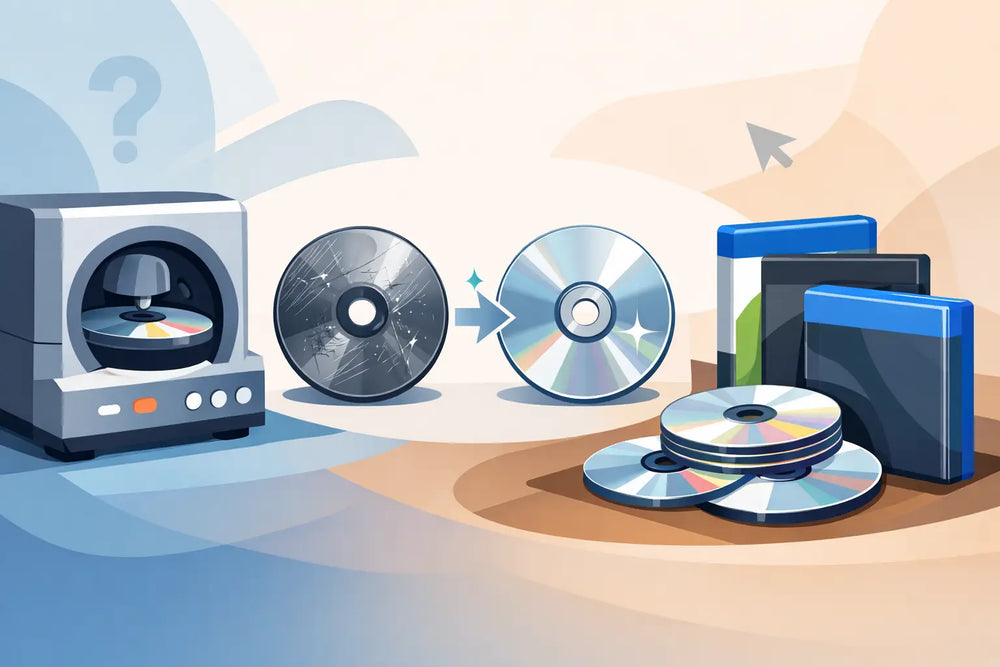
A clean copy of a hard-to-find game can be tempting, especially when the original disc has clearly seen some use. But are resurfaced discs worth buying? Usually, yes - if the price reflects the condition, the disc has been tested, and you understand what resurfacing can and cannot repair.
For physical game collectors, a resurfaced disc is not automatically a bad copy. It is a used disc that has had a very thin layer of its read surface polished to reduce or remove scratches. Done correctly, it can turn a game that skips, freezes, or will not boot into a reliable player. Done poorly, it can leave behind swirl marks, uneven spots, or a disc that still fails when the laser reaches a demanding section of the game.
What Disc Resurfacing Actually Does
Most game discs use a clear polycarbonate layer on the bottom read side. Light scratches in that layer can scatter the console's laser, making it harder to read data. Resurfacing uses a machine and polishing compounds to remove a tiny amount of that plastic, leveling the surface around shallow scratches.
That distinction matters. Resurfacing does not put material back into the disc. It cannot repair everything, and it cannot restore a disc to factory-original condition. It is a practical repair for surface damage, not a magic reset button.
A properly resurfaced disc may look nearly spotless, or it may retain light marks that do not affect play. Visual perfection is nice, but a full test is more valuable than a mirror finish. A game that loads quickly, saves properly, and plays through demanding sections is a better buy than a pretty disc with no testing behind it.
Are Resurfaced Discs Worth Buying? It Depends on the Disc
The value comes down to the platform, the type of damage it had, the game itself, and how the seller handles condition disclosure. For common games, a resurfaced copy should usually cost less than a clean, untouched copy in comparable complete condition. For expensive or difficult-to-find titles, a professionally resurfaced disc can be a sensible way to get a playable original without paying top collector pricing.
The best candidates are discs with ordinary circular scratches from years of use. PlayStation 1, PlayStation 2, original Xbox, Xbox 360, Wii, GameCube, and many DVD-based titles often respond well when the damage is limited to the read surface. That makes resurfaced games especially useful for players building a library they plan to use, not just display.
The trade-off is collector preference. Some collectors want completely original surfaces and will pay more for them. A resurfaced copy may have lower resale appeal to that buyer, even if it works perfectly. If you are buying a sealed display piece or a high-grade collectible, resurfacing is normally a negative. If you are buying a game to put hours into, tested functionality matters far more.
Single-layer discs are usually the safer bet
Standard CD and DVD game discs are generally straightforward to inspect and resurface when the damage is shallow. Blu-ray discs are different. Their data layer sits much closer to the surface, and they use a protective coating that should not be aggressively resurfaced. A scratched PS3, PS4, PS5, Xbox One, or Xbox Series disc needs more caution than an older DVD-era game.
Dual-layer DVDs can also be less forgiving. Games such as certain Xbox 360 and PS2 releases may load normally at first but fail later when the console reads data from the second layer. A seller saying a disc "boots" is useful, but it is not the same as testing an install, a long play session, cutscenes, and areas known to stream data heavily.
Damage on the label side is a different problem
Look at both sides of the disc. On many CD-based games, the label side is much closer to the data layer than the clear side. Pinholes, flaking, deep gouges, or corrosion-looking spots on the label can mean permanent data damage. Resurfacing the bottom will not solve it.
Cracks around the center hub are another warning sign. A tiny hub crack may not stop a disc from playing immediately, but it can spread over time and can damage a console if the disc fails while spinning. That is not a condition issue to ignore just because the read surface looks clean.
How to Inspect a Resurfaced Game Before You Buy
Start with the obvious: ask whether the game was tested after resurfacing. A trustworthy seller should be clear about whether the disc was tested, what condition it is in, and whether it is sold as disc-only or with its original case and inserts. For online purchases, clear photos of both disc sides are worth more than vague labels such as "good" or "pre-owned."
On the read side, look for a consistent finish. Professional resurfacing often leaves fine, uniform lines from the machine rather than random deep scratches. That is normal. What you do not want are cloudy patches, heavy circular grooves, chips along the edge, or sections that look uneven under a bright light.
Check the disc's inner ring and outer edge as well. The clear plastic should not be separating, and the center should not have stress cracks. For cartridge-based games, this exact discussion does not apply, but the same principle does: cosmetic cleanup is fine, while structural damage and corrosion are bigger concerns.
If you are shopping in person, do not be afraid to ask for a closer look. Specialty shops deal with condition questions every day. At Game Quest, disc cleaning and resurfacing are treated as practical service work, not a reason to hide a disc's history. That is the standard to look for anywhere you buy used games.
When a Resurfaced Disc Is a Smart Buy
A resurfaced copy is often the right choice when you want the original physical release at a fair player-grade price. Maybe the game is a childhood favorite, a title you want for a system you actually use, or a harder-to-find release where untouched copies have become expensive. If the resurfaced disc is stable, tested, and priced honestly, it can offer excellent value.
It is also a practical option for multiplayer games and titles that see regular handling. A clean, working copy of a GameCube party game or a PS2 co-op title is meant to be played. Buying a lower-cost resurfaced copy can make more sense than treating an expensive collector-grade disc like it belongs behind glass.
There is also an environmental benefit, although it should not be the main reason to buy. Repairing a usable disc keeps original media in circulation instead of writing it off over surface wear that can be corrected.
When to Pass
Skip a resurfaced disc when the price is close to a cleaner original copy, especially for a title with plenty of supply. There is no reason to pay near-mint money for player-grade condition.
Pass if the seller cannot confirm testing, refuses to show the disc, or describes serious issues with vague language. Be cautious with rare games that have been resurfaced aggressively, as multiple resurfacing passes remove more material each time. A disc can only be polished so many times before it becomes too thin or uneven to read reliably.
You should also walk away from label-side damage, disc rot, warping, deep edge cracks, or a Blu-ray disc that has clearly been treated like an old DVD. Those problems are not routine cosmetic wear.
Player Grade Does Not Mean Poor Quality
Collectors sometimes use "resurfaced" as if it means damaged beyond redemption. That is too simple. Condition exists on a spectrum. An untouched disc with one deep scratch may be a worse purchase than a professionally resurfaced, fully tested disc that works every time.
The key is buying with the right expectation. A resurfaced game belongs in the player-grade category unless the seller can document otherwise. It may not be the best choice for a condition-focused collection, but it can be exactly what a working library needs.
If you are choosing between copies, prioritize a tested disc, an honest condition description, and a price that leaves room for its resurfacing history. A game is meant to be read, loaded, and played - and a clean-running player-grade disc can still earn a permanent spot on your shelf.